

Transfer pump system
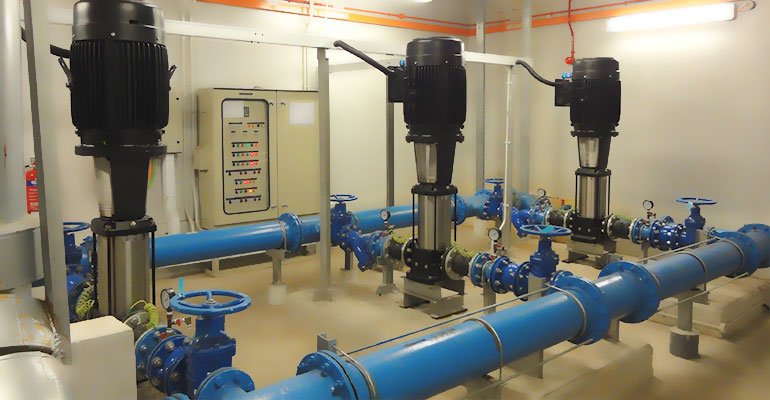
A transfer pump system moves water from a low-level transfer tank (usually in the basement or at Level 1) up to the roof storage tank at the top of the building. From the roof tank, water then flows down to serve every floor by gravity, or feeds a booster set for the higher units. Any building tall enough to store water at roof level needs this tank-to-tank transfer duty, and that is exactly what Waves Fluid Engineering Pte Ltd designs, supplies, installs, services and repairs across Singapore.
Also known as: water transfer pump, cold water transfer pump, transfer pump set, transfer booster set, tank-to-tank pump and riser transfer pump. All refer to the same duty of lifting water from a lower tank to a higher tank.
How a transfer pump system works
In Singapore, buildings above a certain height cannot rely on mains pressure alone to reach the upper floors, so water is stored and moved in stages. A transfer pump system is the middle stage that keeps the roof tank topped up:
1
Mains fills the transfer tank
PUB water enters the low-level transfer tank in the basement or at Level 1 through a ball float valve.
2
Pumps lift it to the roof
The transfer pumps push water up the riser and discharge it into the roof storage tank.
3
Gravity serves the building
Water flows down from the roof tank to each floor, or feeds a booster pump for the top units.
Why buildings in Singapore need a transfer pump
Tall buildings are required to hold their own water storage rather than draw everything straight from the mains. Because the storage sits at roof level, the water first has to be raised there from the incoming supply held in the transfer tank below. Without a working transfer pump system, the roof tank empties and the upper floors lose supply. Transfer pump systems are commonly installed in:
- Commercial buildings and office towers
- Industrial buildings and factories
- Condominiums and residential blocks
- Shopping complexes and mixed-use developments
- Hospitals and schools
- Dormitories and other high-usage premises
Transfer pump vs booster pump
These two systems are often confused because both raise water in a building, but they do different jobs. A transfer pump moves water from one tank to another (transfer tank up to roof tank) and simply keeps the roof tank filled. A booster pump system takes water from a tank and holds a constant, pre-set pressure in the supply line to the outlets. Many buildings use both: the transfer pump keeps the roof tank full, and a booster set pressurises the upper floors that gravity alone cannot reach.
System configurations
We size and configure the transfer set to your building's water demand and the number of pumps your consultant's drawing calls for:
2
Duplex (two-pump)
The standard set. One pump runs on duty while the second stands by, and they alternate to share wear and provide backup.
3
Triplex (three-pump)
For very high demand such as large dormitories and big complexes, where extra capacity and redundancy are needed.
+
With SMS / BMS monitoring
Add fault alerting so your facilities team is notified by SMS, with a dry contact to link the panel to the building BMS.
Components of a transfer pump system
A complete transfer pump system is built from the following parts. Sizes and options are matched to your building on quotation.
| Component | Details |
|---|---|
| Transfer pumps | Two or three fresh-water pumps (duty plus standby) sized to lift water from the transfer tank to the roof tank |
| Control panel | Automatic duty / standby operation, pump alternation, overload protection and fault alarm, with dry contact for BMS |
| Level control (transfer tank) | Electrode probes or float switches for low-level cut-off, preventing dry running when the transfer tank is empty |
| Level control (roof tank) | Electrode probes or float switches that start and stop the pumps as the roof tank drops and refills |
| LED indicators | Show run, standby, trip and fault status of each pump for quick on-site diagnosis |
| Valves & fittings | Swing check valve and gate valve on each pump, Y-strainer on the suction side and flexible connectors to reduce vibration |
| Pressure gauge | For monitoring discharge pressure and confirming healthy pump performance |
Dry-run protection and level control
Transfer pumps fail fastest when they run dry, so protection is built into every system we install. Electrode wires (or float switches) run from the transfer tank back to the control panel and cut the pumps the moment the tank runs low, so the pumps never run without water. A second set of probes in the roof tank starts the pumps when the level drops and stops them once the tank is full, so the transfer runs automatically around the clock with no manual switching.
Brands we supply
We select the pump on flow rate, the lift (head) required to reach your roof tank and the space in your plant room. Vertical multistage pumps are the usual choice for transfer duty because they deliver high head in a compact footprint.
Grundfos
Most specifiedCR / CRE vertical multistage
- TypeVertical multistage
- Best forHigh-rise roof-tank transfer
Wilo
Quiet & efficientHelix / Multivert MVI
- TypeVertical multistage
- Best forLow-noise, high-head lift
Lowara
Compacte-SV series
- TypeVertical multistage
- Best forTight plant rooms
Tsurumi
Heavy dutyEnd-suction / transfer range
- TypeEnd-suction centrifugal
- Best forHigh-flow, robust duty
Also available: Vossche and other leading pump brands, supplied and serviced on request. We keep common pumps and spares ex-stock to avoid delays in delivery.
Recent installations
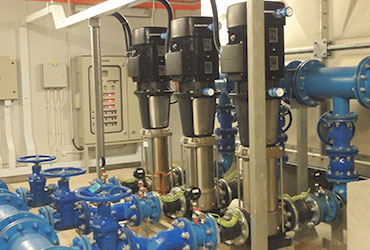
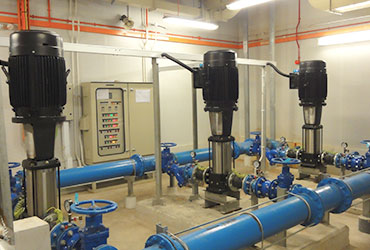
Our services for transfer pump systems
- New system design, supply and installation to the consultant's drawing, with testing and commissioning
- Scheduled servicing and maintenance of existing transfer pump systems
- Repair and replacement of pumps, control panels, electrodes / float switches and valves
- Fault-finding on pumps that trip, run dry, cycle repeatedly or fail to fill the roof tank
New system
For a new transfer pump system
- Design the system from your drawing, or collect the consultant's drawing with the pump requirements.
- Suggest a few suitable brands for your selection.
- Quote based on the brand you choose.
- Install the system, including testing and commissioning.
Repair
For a faulty transfer pump system
- Visit your premises at a time convenient to you.
- Identify the problem in the existing system or parts.
- Give an obligation-free quotation for the repair or replacement works.
- On your approval, carry out the works with utmost quality.
Our certifications
BCA ME11
Mechanical Engineering, L1
BCA GB1
General Builder Class 1
bizSAFE Star
Workplace Safety & Health
ISO 9001:2015
Quality Management System
Warranty
One-year warranty on parts we install
All spare parts we use are genuine parts supplied by globally recognised manufacturers. We provide a one-year warranty against products changed and/or installed by Waves Fluid Engineering Pte Ltd at your premises (subject to terms and conditions).
Related pump systems & services
One-pump system
Two-pump booster system
Sump pump system
Ejector pump system
Pump maintenance works
Pump system repair works
Frequently asked questions
What is a transfer pump system?
It is a set of pumps that moves water from a low-level transfer tank (usually in the basement or at Level 1) up to the roof storage tank. From the roof tank the water then serves the building by gravity, or feeds a booster set. It keeps the roof tank filled so the upper floors never run out of water.
What is the difference between a transfer pump and a booster pump?
A transfer pump moves water from one tank to another and keeps the roof tank filled. A booster pump takes water from a tank and holds a constant, pre-set pressure in the supply line to the outlets. Many buildings run both: the transfer pump fills the roof tank, and a booster set pressurises the higher floors.
How many pumps does a transfer system need?
Most buildings use a two-pump (duplex) set, with one pump on duty and one on standby that alternate to share wear and provide backup. Very high-demand premises such as large dormitories and big complexes may need a three-pump (triplex) set. We size the configuration to your building's water demand and your consultant's drawing.
What stops the pump from running dry?
Electrode wires or float switches run from the transfer tank to the control panel and cut the pumps when the tank runs low, so they never run without water. A separate set of probes in the roof tank starts and stops the pumps as the roof tank drops and refills, so the transfer runs automatically.
Which pump brands do you supply for transfer duty?
We supply Grundfos (CR / CRE), Wilo (Helix, Multivert MVI), Lowara (e-SV) and Tsurumi, with Vossche and other leading brands available on request. Vertical multistage pumps are the usual choice because they give high head in a compact footprint. We recommend the model based on flow, the lift required and the plant-room space.
How often should a transfer pump system be serviced?
We recommend scheduled servicing (typically quarterly, depending on usage) to check the pumps, control panel, electrodes / float switches, check valves and pump alternation. Regular servicing catches worn seals, sticking valves and faulty level probes before they cause a roof-tank supply failure. We offer maintenance contracts.
Do you repair existing or other-brand transfer pumps?
Yes. We visit at your convenience, identify the fault in the existing system or parts, provide an obligation-free quotation, and carry out the repair or replacement on your approval, whatever the pump brand.
Do you provide a warranty?
Yes. We use genuine spare parts from globally recognised manufacturers and provide a one-year warranty on products changed and/or installed by us at your premises, subject to terms and conditions.
Need a transfer pump system or servicing?
Call or WhatsApp +65 9487 0446 or email sales@wavesfluid.com.sg for a quotation and site visit.