

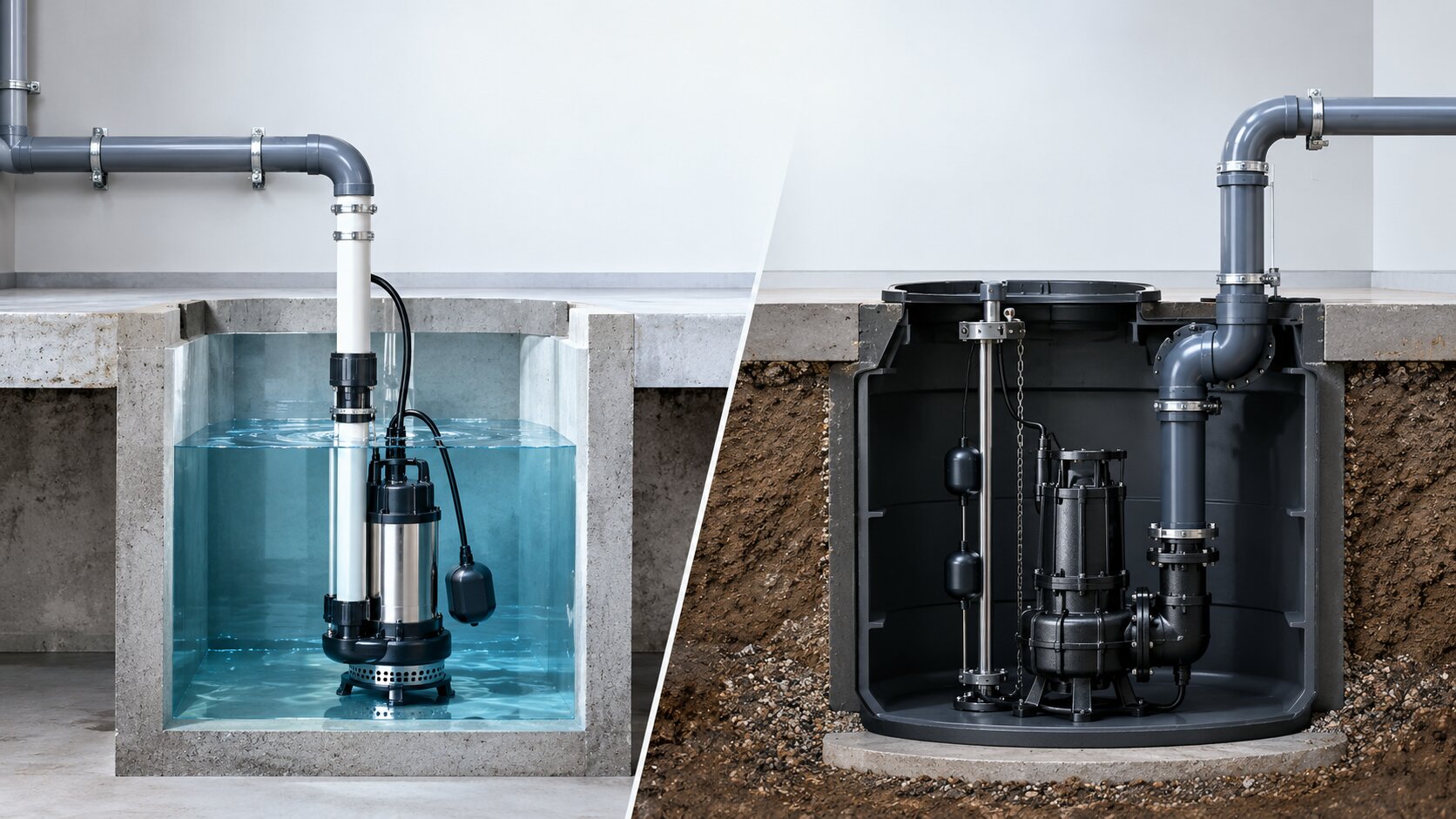
Both sit in a pit below ground level. Both switch on by themselves when the water rises. Both are the reason your basement is not flooded right now. So building staff use the two names interchangeably all the time, and then order the wrong replacement pump when one fails.
They are not the same. A sump pump clears collected water, usually rainwater and seepage. An ejector pump lifts sewage and toilet waste up to the sewer. Different water, different discharge point, and in Singapore, two different PUB codes of practice. Here is how to tell them apart and why it matters.
Key takeaway: if the water came from the sky or the ground, it is a sump pump. If it came from a toilet, it is an ejector pump.
The short answer
| Sump pump | Ejector pump | |
|---|---|---|
| Handles | Rainwater, seepage, wash-down water | Toilet waste and sewage |
| Sits in | A sump pit or collection trench | An ejector tank inside an ejector pit |
| Discharges to | The development's internal drainage | The manhole inspection chamber and sewer |
| Solids handling | Light silt and grit | Solids, tissue and sewage |
| Governed by | Code of Practice on Surface Water Drainage | Code of Practice on Sewerage and Sanitary Works |
| Typical trigger | Heavy rain, ground seepage | Everyday use of toilets below sewer level |
What a sump pump actually does
A sump pump exists because water ends up somewhere it cannot drain away from by gravity. In a Singapore building that is almost always a basement or car park sitting below the level of the drain outside. Rain blows in at the ramp, groundwater seeps through the structure, and a wash-down leaves water on the floor. All of it runs to the lowest point, which is the sump pit.
Float switches in the pit start the pump when the water rises and stop it when the level drops. Larger installations use two pumps with a control panel so one can run while the other stands by, which is what most basement car parks have. You can read the full technical breakdown on our sump pump system page.
The water a sump pump handles is relatively clean. It carries silt, grit and the occasional leaf or rag, but no sewage. That is why sump pumps do not need the large internal passages that sewage pumps do.
What an ejector pump actually does
An ejector pump solves a completely different problem: a toilet installed below the level of the public sewer. Waste from that toilet cannot flow out by gravity, so it collects in an ejector tank inside an ejector pit, and the ejector pumps lift it up to the manhole inspection chamber outside the building.
Two arrangements are common here. A standard system has two ejector pumps fitted inside the ejector tank, connected to the public manhole IC, and suits small residential buildings. A customised system uses dry-mounted ejector pumps with the ejector tank, and is used for most other building types. Details are on our ejector pump system page.
Because this pump handles sewage, its construction is different. Under PUB's Code of Practice on Sewerage and Sanitary Works, a pump receiving discharge from toilets and food establishments must have a minimum free passage of 64mm, with the discharge pipe larger than that free passage. The code also requires duty and standby pumps with reflux and isolating valves, and states the pump must not be oversized, with a discharge rate not exceeding three times the inflow rate.
The overlap that causes most of the confusion
Here is the detail that makes people mix the two up, and it is a legitimate reason for the confusion rather than carelessness.
An ejector pump system always contains a sump pump too. The ejector pit needs its own small pump to clear the used water that collects from washing down the ejector tank and the pit itself, and that water also goes to the manhole IC. So in one pit you have ejector pumps handling sewage from the tank, and a separate sump pump handling wash-down water around it.
If someone points at that pit and says "the sump pump is faulty", they might mean either machine. This is exactly how a building ends up with a replacement pump that physically fits but is rated for the wrong duty.
Three differences that actually matter
1. What is in the water
Put a standard drainage pump on sewage duty and it will block. The impeller and passages are simply not sized for solids and tissue, so the pump clogs, overheats and trips, often within weeks. Going the other way is less dangerous but wasteful: a sewage-rated pump on a clean rainwater sump costs considerably more than the job needs.
2. Where it discharges
This one has regulatory consequences. Sewage from an ejector pump goes to the manhole IC and into the sewer. Storm water from a basement sump follows the surface water drainage route, and the current code is specific about it: a basement pumped drainage system should not discharge directly into the roadside or public drain. The outlet is taken through a swan neck connection into the development's internal drain or internal sump first.
Cross-connecting the two, so that storm water ends up in the sewer or sewage ends up in the drain, is a compliance problem, not a plumbing preference.
3. Which code applies
A basement storm water sump is designed under the Code of Practice on Surface Water Drainage, which sets standby redundancy of at least N duty plus 1 standby for general developments (and N duty plus N standby for other development types), a pump sump sized to hold the inflow from the whole catchment for at least three hours, and generator backup if main power fails.
An ejector installation is designed under the Code of Practice on Sewerage and Sanitary Works instead, with the free passage and discharge rate requirements noted above. Two different rulebooks, two different submissions, and your Qualified Person or PE confirms what applies to your project.
How to tell which one you have
- Follow the smell. An ejector pit has an odour and is usually sealed and vented. A storm water sump pit normally is not.
- Find the discharge. If the pipe runs to a manhole IC, it is sewage. If it runs into an internal drain or internal sump on the site, it is storm water.
- Look for a tank inside the pit. Ejector systems have a sealed ejector tank. A plain sump pit has no tank, just the pit itself.
- Check when it runs. A pump that only works hard after heavy rain is a sump pump. One that cycles all day regardless of weather is handling waste water.
- Read the nameplate. Sewage and vortex pumps state their solids handling or free passage size. Drainage pumps usually do not.
What this means for maintenance
The two fail in different ways, so they need different attention.
Sump pumps fail quietly. They sit idle for weeks, silt builds up in the pit, a float switch gets tangled or stuck, and nobody finds out until the night it rains hard and the standby pump turns out to have seized. The fix is scheduled servicing that clears the pit, frees the floats and actually proves the standby pump runs rather than assuming it does.
Ejector pumps fail loudly and unpleasantly. Blockages from wipes and rags, worn impellers and failed seals are common, and an overflowing ejector or holding tank can mean a PUB fine, not just a mess. Many buildings add a holding tank SMS alert system that messages the facilities team when the level reaches high, precisely to avoid that.
Both benefit from the same basic discipline: quarterly pump maintenance, working float switches, and a standby pump that is tested rather than trusted.
Getting it wrong is expensive
The common failure scenarios are predictable. A drainage pump gets ordered as a like-for-like replacement for an ejector pump and blocks within a month. A single pump replaces what should be a duty and standby pair, and the building now has one point of failure between it and a flooded car park. Or the discharge is reconnected to the wrong route during a renovation, which nobody notices until an inspection.
None of these are dramatic engineering failures. They are specification mistakes, and they are avoidable by confirming what the pump is actually handling before anything is ordered.
Not sure what you have?
If you are looking at a pit and cannot tell whether it is a sump or an ejector installation, or you have inherited a system with no drawings, our engineers can inspect it, identify what is installed and advise on the correct replacement or servicing. We design, supply, install and maintain both across Singapore, including systems other contractors installed. See our full range of water pump systems, or get in touch for a site visit.
Frequently asked questions
Is a sump pump the same as an ejector pump?
Can I use a sump pump for sewage?
Why does an ejector pump system also have a sump pump?
How do I know which pump my building has?
Where should a basement sump pump discharge to?
How often should these pumps be serviced?
Talk to our engineers
Call or WhatsApp +65 9487 0446 for a site visit and quotation.


